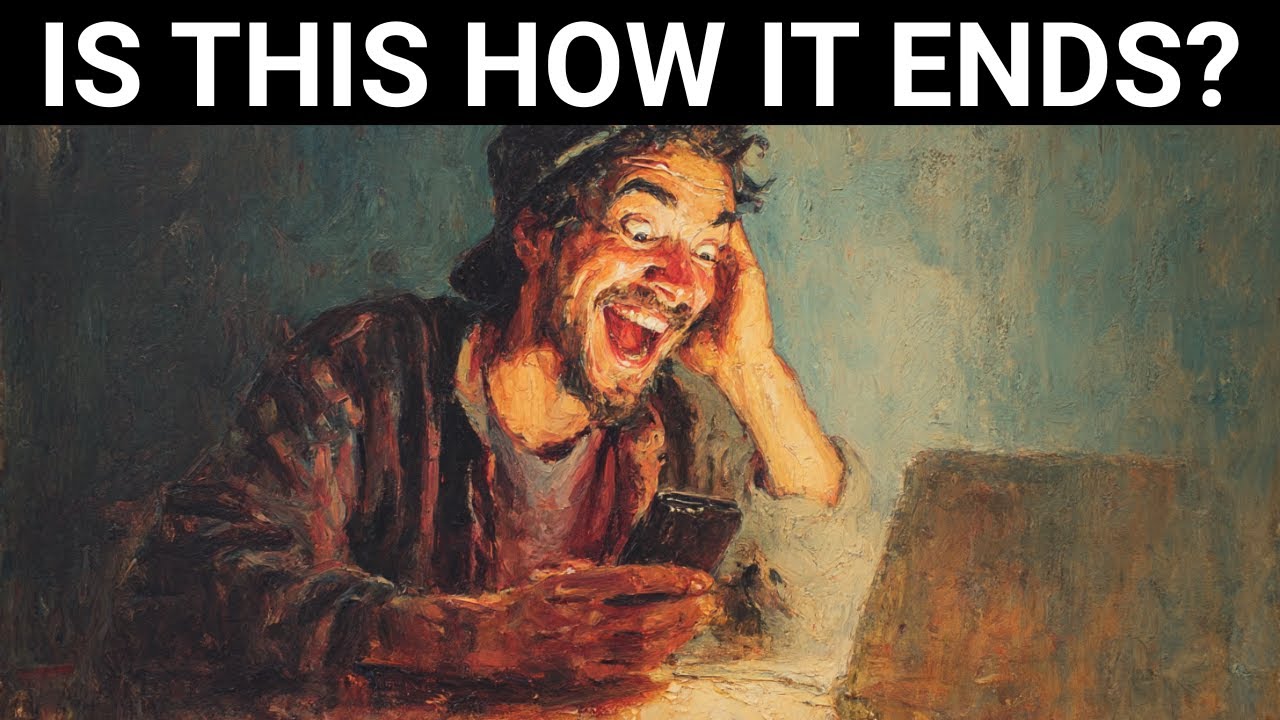
Why Social Media Is Making Us Extinct – Aldous Huxley Predicted This

Aldous Huxley and Brave New World: The Dark Side of Pleasure
Are we voluntarily choosing our own extinction? In this video, we explore how social media is literally rewiring our brains, destroying our ability to think deeply, and pushing humanity toward a future eerily similar to Aldous Huxley’s Brave New World.

From Facebook’s own studies showing Instagram harms teenage mental health, to modern neuroscience revealing how dopamine pathways are hijacked by our feeds, we’re seeing Huxley’s prophecy unfold in real-time.

You’ll discover:
📱 How algorithms manipulate your dopamine and attention spans
🧠 Why your brain is losing its ability to experience genuine satisfaction
🤖 How we’re becoming algorithmic clones, losing individuality and creativity
🧬 The shocking evolutionary risks of digital addiction
💡 Practical ways to resist: neuroplasticity, digital detox, and reclaiming your mind

Aldous Huxley warned us nearly a century ago. Are we too distracted to notice?
👉 If this video made you rethink your relationship with technology, give it a thumbs up, comment your thoughts below, and share it with someone trapped in the scroll.
Subscribe for more philosophical deep dives into the psychology, technology, and power structures shaping our future.

Tags:
Aldous Huxley interviewed by Mike Wallace : 1958 (Full)
THE PSYCHEDELIC PHILOSOPHER: A Guide To Aldous Huxley
Do We Live in a Brave New World? – Aldous Huxley’s Warning to the World
Love Your Servitude – Aldous Huxley & George Orwell
Most People Have Quietly Given Up, and No One’s Noticed | Aldous Huxley
Aldous Huxley on Technodictators
The Hidden Price of Pleasure in the Modern World | Aldous Huxley

#AldousHuxley #BraveNewWorld #SocialMedia #Dopamine #Psychology #DigitalAddiction #Neuroplasticity

Social Media: Crash Course Navigating Digital Information #10

Today, in our series finale, we’re going to talk about the great white whale of navigating online information: your social media feed. Social media shapes both our online and offline behaviors from how we engage in communities and consume goods and services to influencing our thoughts and opinions. So let’s talk about how they really function – the good stuff and also the terrible stuff.

We know that navigating our current information environment can be frustrating, and we hope this series has helped you develop the habits to navigate our digital world a bit more confidently. Thanks so much for watching!

Read more about YouTube’s effort to improve recommendations here:
https://youtube.googleblog.com/2019/01/continuing-our-work-to-improve.html

Special thanks to our partners from MediaWise who helped create this series:
The Poynter Institute
The Stanford History Education Group (sheg.stanford.edu)

Follow MediaWise and their fact-checking work across social:
https://www.instagram.com/mediawise/
https://www.youtube.com/mediawise

https://www.facebook.com/MediaWise/

MediaWise is supported by Google.

Crash Course is on Patreon! You can support us directly by signing up at http://www.patreon.com/crashcourse

Thanks to the following patrons for their generous monthly contributions that help keep Crash Course free for everyone forever:

Eric Prestemon, Sam Buck, Mark Brouwer, Bob Doye, Jennifer Killen, Naman Goel, Nathan Catchings, Brandon Westmoreland, dorsey, Indika Siriwardena, Kenneth F Penttinen, Trevin Beattie, Erika & Alexa Saur, Glenn Elliott, Justin Zingsheim, Jessica Wode, Tom Trval, Jason Saslow, Nathan Taylor, Brian Thomas Gossett, Khaled El Shalakany, SR Foxley, Sam Ferguson, Yasenia Cruz, Eric Koslow, Caleb Weeks, Tim Curwick, D.A. Noe, Shawn Arnold, Malcolm Callis, William McGraw, Andrei Krishkevich, Rachel Bright, Jirat, Ian Dundore

Want to find Crash Course elsewhere on the internet?
Facebook – http://www.facebook.com/YouTubeCrashCourse
Twitter – http://www.twitter.com/TheCrashCourse
Tumblr – http://thecrashcourse.tumblr.com
Support Crash Course on Patreon: http://patreon.com/crashcourse

CC Kids: http://www.youtube.com/crashcoursekids